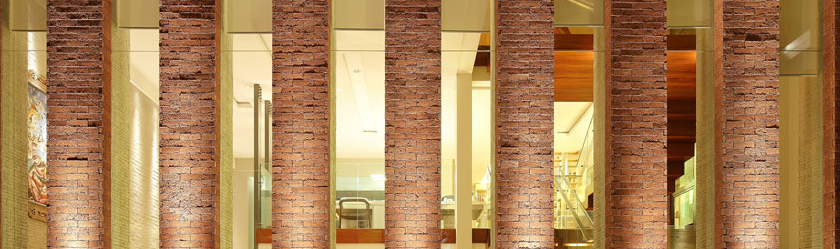
The site is located in Xiashi, a traditional Hakka village in Pinghe County, Fujian Province. There are two round Tulous (earth buildings) separated by a creek at the center of the village. According to legend, the families of the two Tulous were enemies in earlier times. The creek was the boundary between them, demarcating their lack of interaction. The yellowish brown color of the Bridge School ties the Tulous together at the same time that the sharpness of the suspended bridge building is a stark contrast to their roundness.
Tulou are a unique congregate housing form, reflecting clan culture and the introverted, defensive and turbulent past of Hakka settlements. Today the traditional culture gives a tranquil charm and rich cultural heritage to the village. But, under the influence of the cultural patterns, village households remain separate with little but muddy land between them. The village lacks public spaces for in which to gather, communicate or cohere.
Indigenous culture, environments and situations are typical concerns of Li Xiaodong’s. They have also often been the focus of his designs. In this village, the architect identified the lack of interpersonal communication between villagers with the lack of public space. He saw that residents on both sides of the creek had little interaction due to the inconveniences of making contact, and that local development was slow or even stagnant due to the scarcity of resources and the remote location of the village.
The idea that “a Hope Primary School might be the opportunity to optimize this primitive spatial system” arose spontaneously. A “bridge,” traversing the creek and connecting the two Tulous, was inspiration that Li Xiaodong got from the area. Combining the primary school with the bridge becomes the main concept of the design, a move that could link the “broken” Tulous and simultaneously activate a space at the center of the village. The Bridge School could connect the past, present, and future.
The site is located in Xiashi, a traditional Hakka village in Pinghe County, Fujian Province. There are two round Tulous (earth buildings) separated by a creek at the center of the village. According to legend, the families of the two Tulous were enemies in earlier times. The creek was the boundary between them, demarcating their lack of interaction. The yellowish brown color of the Bridge School ties the Tulous together at the same time that the sharpness of the suspended bridge building is a stark contrast to their roundness.
Tulou are a unique congregate housing form, reflecting clan culture and the introverted, defensive and turbulent past of Hakka settlements. Today the traditional culture gives a tranquil charm and rich cultural heritage to the village. But, under the influence of the cultural patterns, village households remain separate with little but muddy land between them. The village lacks public spaces for in which to gather, communicate or cohere.
Indigenous culture, environments and situations are typical concerns of Li Xiaodong’s. They have also often been the focus of his designs. In this village, the architect identified the lack of interpersonal communication between villagers with the lack of public space. He saw that residents on both sides of the creek had little interaction due to the inconveniences of making contact, and that local development was slow or even stagnant due to the scarcity of resources and the remote location of the village.
The idea that “a Hope Primary School might be the opportunity to optimize this primitive spatial system” arose spontaneously. A “bridge,” traversing the creek and connecting the two Tulous, was inspiration that Li Xiaodong got from the area. Combining the primary school with the bridge becomes the main concept of the design, a move that could link the “broken” Tulous and simultaneously activate a space at the center of the village. The Bridge School could connect the past, present, and future.
The site is located in Xiashi, a traditional Hakka village in Pinghe County, Fujian Province. There are two round Tulous (earth buildings) separated by a creek at the center of the village. According to legend, the families of the two Tulous were enemies in earlier times. The creek was the boundary between them, demarcating their lack of interaction. The yellowish brown color of the Bridge School ties the Tulous together at the same time that the sharpness of the suspended bridge building is a stark contrast to their roundness.
Tulou are a unique congregate housing form, reflecting clan culture and the introverted, defensive and turbulent past of Hakka settlements. Today the traditional culture gives a tranquil charm and rich cultural heritage to the village. But, under the influence of the cultural patterns, village households remain separate with little but muddy land between them. The village lacks public spaces for in which to gather, communicate or cohere.
Indigenous culture, environments and situations are typical concerns of Li Xiaodong’s. They have also often been the focus of his designs. In this village, the architect identified the lack of interpersonal communication between villagers with the lack of public space. He saw that residents on both sides of the creek had little interaction due to the inconveniences of making contact, and that local development was slow or even stagnant due to the scarcity of resources and the remote location of the village.
The idea that “a Hope Primary School might be the opportunity to optimize this primitive spatial system” arose spontaneously. A “bridge,” traversing the creek and connecting the two Tulous, was inspiration that Li Xiaodong got from the area. Combining the primary school with the bridge becomes the main concept of the design, a move that could link the “broken” Tulous and simultaneously activate a space at the center of the village. The Bridge School could connect the past, present, and future.

 Hong Kong SAR




 Australia
 Indonesia
 Malaysia
 New Zealand
 Philippines
 Singapore